It began with an eight-week manuscript sprint. Then came the bestseller lists, the television crews, a home-office publishing operation and a bookshelf that kept growing.
34Books co-written by Jim Carroll & Rick Broadhead
1.5M+Copies sold
1994The breakthrough year
The remarkable publishing run
Before the world was online.
In November 1993, publisher Ken Proctor of Prentice Hall Canada saw a problem: most books explaining the Internet were written for Americans. Jim Carroll understood the technology. Rick Broadhead had assembled an invaluable Canadian directory. Christa Carroll knew how to turn their work into a finished, readable book. Together, they seized the moment. The Canadian Internet Handbook appeared in 1994 and became a national bestseller.
Over the following years, they wrote an extraordinary range of books that helped readers understand the Internet's emerging impact on business, finance, healthcare, commerce and everyday life.
Christa did much more than proofread. She challenged both authors on what belonged in each book, rewrote technical sections for real readers, managed editorial production and typeset the first handbook herself in Microsoft Word. A contemporary February 1999 article records that she had left her financial comptroller position in 1995 to join the home-office business full time. The first manuscript and camera-ready production moved at a speed conventional book production could rarely match. A sustained publishing operation followed, not just a single lucky bestseller.
These books predate Oblio Press, founded in 2004. The publishers named below are their original publishing houses. This is a historical bibliography, not a claim that Oblio published the original editions.
A remarkable sequence, documented in the archive
FROM FIRST WORDS TO NATIONAL BESTSELLER.
The story is not that the Internet happened and a few authors wrote about it. It is how fast Jim Carroll, Rick Broadhead and Christa Carroll responded when the opportunity arrived, and how a family home became a high-output publishing operation.
22 NOV 199310:54 AM
Jim's memoir records the exact minute he began writing the first book. Prentice Hall Canada had identified the need for a practical Canadian Internet guide. Rick brought a directory of resources; Jim brought the technical knowledge.
THE FIRST TWO MONTHS8 WEEKS
Jim and Rick completed the manuscript on a compressed schedule. Christa edited, challenged, designed and typeset it in Microsoft Word, preparing camera-ready pages for a publisher accustomed to a much slower production cycle.
FEB–MAR 1994IN PRINT
The book went to press in February and was covered in the Toronto Star on March 6. The original article, preserved in the family archive, describes the new Canadian guide and photographs Jim and Rick holding it.
02 JUL 1994#1
The original framed Financial Post chart confirms The Canadian Internet Handbook at number one on its paperback nonfiction bestseller list. Other newspaper listings and months of coverage followed.
A note on the eight-week milestone: it refers to the extraordinary initial manuscript and production sprint. The dated record separately places the printing in February 1994. We're retaining both rather than suggesting that every stage from first keystroke to bookstore shelf happened in precisely eight weeks.
From the Carroll family archive
This is what acceleration looks like.
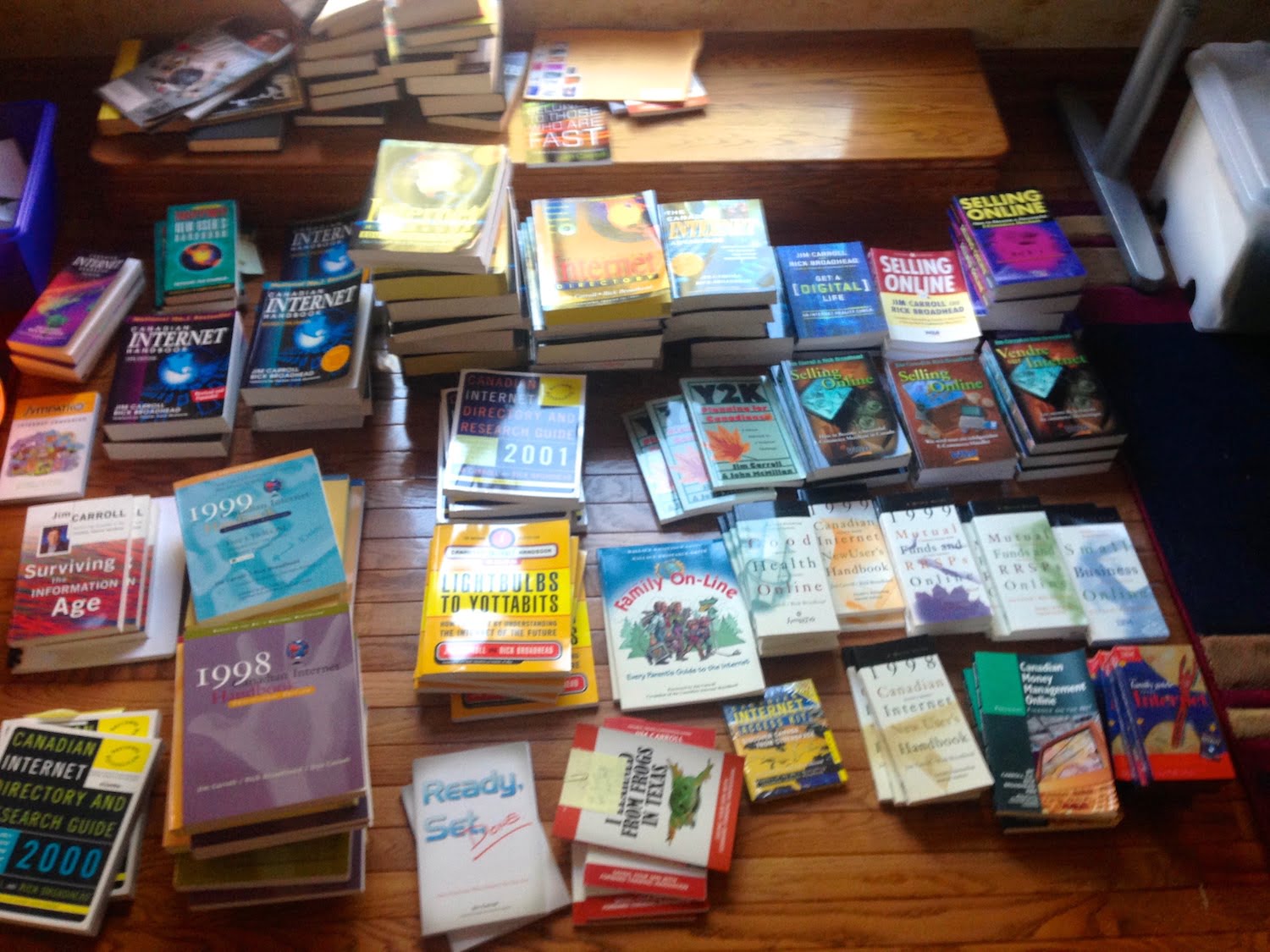
An extraordinary range of titles on Internet access, commerce, finance, healthcare and the connected future. Photograph supplied from the Carroll family collection; titles shown span several publishing periods.
In 1996 alone, the team released five books within a few months. At the same time, Jim and Rick were making television and radio appearances and launching NetTalk; Jim was speaking several times a week; and Jim and Christa were raising two young children while renovating their home office.
The original books were published by Prentice Hall and other publishers. What made the output possible was an unconventional collaboration, with Christa providing sustained editorial judgement, manuscript production and the business infrastructure behind the work.
The years everything accelerated
A publishing phenomenon. A very human story.
1993
A Canadian idea in a very American market
Prentice Hall Canada publisher Ken Proctor spots the opening. Jim brings years of technology expertise; Rick brings the province-by-province Internet directory. Christa becomes the editorial and production force that can bring the manuscript across the finish line.
1994
The book arrives. Everything changes.
The first Canadian Internet Handbook is typeset in-house and reaches readers in March. It becomes a national bestseller, taking what had been a technical niche into bookstores, media interviews and speaking engagements across Canada. The framed July 2, 1994 Financial Post clipping now independently confirms the number-one paperback nonfiction ranking. A later first-person article also identifies the Toronto Star and Montreal Gazette among the papers carrying bestseller lists.
1995–96
From one bestseller to a whole bookshelf
In 1995, PROFIT magazine features Jim on its cover, documenting the unusual home-office business behind the books. The operation expands into directories, Internet education, business strategy, healthcare, personal finance and much more. During one extraordinary stretch in 1996, five titles are released within a few months, while the family also juggles a national radio show, several speaking engagements each week, two young children and a home-office renovation.
1990s
Sixty thousand copies in one order
One of the clearest illustrations of the books' commercial reach: Visa commissions a customized edition of Selling Online and purchases 60,000 copies to distribute. This was publishing that reached well beyond the traditional bookshop.
2000–04
A new chapter after the Internet boom
As the first dot-com era unwinds, Jim and Rick take their careers in different directions. Jim's focus widens from Internet strategy to innovation, leadership and the future; in 2004, Jim and Christa establish Oblio Press as their own independent publishing imprint.
And in the middle of it all: Christa. The editor who could argue over a chapter, produce camera-ready pages, manage the business and make space for a young family. Jim has repeatedly explained that he offered her co-author credit; she declined. The editorial partnership nevertheless shaped the books. The books may have carried two familiar names on their covers. The publishing operation had a third indispensable creative partner.
Practical guidance for small businesses moving into the online economy.
1999
Y2K Planning for Canadians
Jim Carroll & John McMillan · CDG Books Canada
A human-centered guide to a consequential technical challenge.
2000
Selling Online
Jim Carroll & Rick Broadhead · CDG Books Canada
A guide to developing a successful e-commerce business in Canada; a US edition followed.
2000
From Light Bulbs to Yottabits
Jim Carroll & Rick Broadhead · Stoddart Publishing
A look at the scale of the connected future, and the book that later inspired the YottaBit project.
2002
Get a (Digital) Life
Jim Carroll & Rick Broadhead · Stoddart Publishing
An Internet reality check as the first dot-com era wound down.
A pivotal book
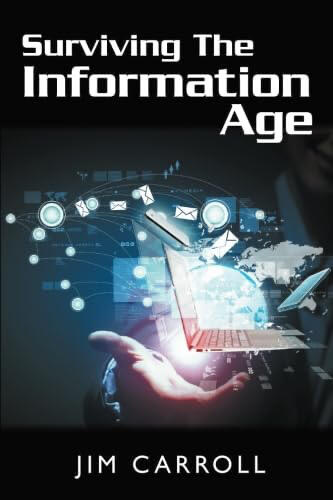
Surviving the Information Age.
Originally published in 1997 and later reissued, this book holds a special place in the story. Jim has described it as effectively co-written with Christa, recognizing the depth of her influence on the finished work. The original edition credits Jim as its named author.